|
Learn the U.S. Constitution
|
|
|
|
| Follow @LearnTheConst |
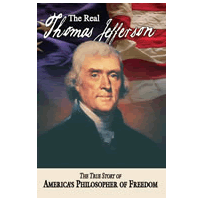
During the first five decades of this nation's history, Jefferson was preeminent among his peers as an advo-cate of the rights of man. The inspiring appeal of his philosophy and the eloquent force of his expression have made him a powerful symbol of freedom throughout the Western world, and his influence has been even greater in death than in life. Because of this tremendous influence, hosts of "experts' have predictably come forward and altered the Jeffersonian image to accommo-date partisan political objectives. Some have chosen to dwell on Jefferson's personal character. He has been, variously portrayed as either a scoundrel or a demigod, depending on the author's purpose. One recent product of the vilification school, for instance, is a popular "psychobiography" which has now found its way into most American libraries. Claim-ing to be an "intimate history" of Jefferson's private life, the book focuses largely on his alleged lust for an en-chanting slave mistress. It has Jefferson suffering from a near-schizophrenic condition as he desperately struggles to conceal his scandalous immorality in order to retain the esteem of the country he loves. As the following pages will demonstrate, this bizarre tale-like so many others about notable figures of the past-bears no resemblance to historical fact. Others have preferred to explore Jefferson's system of ideas on government, economics, education, or some other subject. But whatever side of him is treated, the standard approach among today's writers is to "analyze" and "interpret" him for the reader. We are not permitted to look at Jefferson directly, but rather through the eyes of various authors who summarize what he did and paraphrase what he said, then carefully explain why he did and said those things. Every few years another author comes along with still one more "fresh interpretation." As these pile up, one on top of another, the thoughtful reader begins to wonder who in the world Thomas Jefferson really was. That is precisely why The Real Thomas Jefferson has been published. The title may seem presumptuous at first glance, but it is not meant to suggest that those of us who prepared the book are gifted with superior insight. Indeed, we have made a conscious effort to keep ourselves out of the picture. By allowing Jefferson to explain his life and ideas in his own words, we have tried to ensure that his spirit, not ours, will breathe in these pages-so that all who read them will become acquainted with Jefferson himself, not another second-hand interpretation of him. For reasons already noted, Jefferson's life and thought have been misrepresented and misconstrued by Ameri-cans of the twentieth century. Yet before we can ap-preciate and utilize his magnificent vision of a free republic, we must correctly understand both his life and his ideas. Thus the two-part format of this volume: the biography in Part I and the selected quotations in Part 11 are complementary elements, each making the other more meaningful and providing a fuller portrait of the real Jefferson. As we have indicated, the book consists mostly of Jefferson's own words; even the biography is drawn chiefly from his writings. In both sections the passages quoted are carefully documented from original sources. This volume is part of a series being published by the National Center for Constitutional Studies, which has been established to help restore Constitutional principles in the tradition of America's Founding Fathers. The AMERICAN CLASSIC SERIES is designed to revive an in-telligent appreciation of the Founders and the remarkable system of free government which they gave us. The nation these men built is now in the throes of a political, economic, social, and spiritual crisis that has driven many to an almost frantic search for "modern solutions." Ironically, the solutions have been readily available for nearly two hundred years in the writings of our Founding Fathers. An honest examination of twentieth-century American history reveals that virtually every serious problem that has developed in our society can be traced to an ill-conceived departure from the sound principles taught by these great men. The citizen of today who turns back to the Founders' writings is often surprised by their timeless relevance-and perhaps equally dismayed that we have permitted ourselves to stray so far from such obvious truths. It is our earnest hope that the AMERICAN CLASSIC SERIES will prove to be an inspiration and a valuable resource to those who believe that this nation can yet fulfill its "manifest destiny" as a bulwark of freedom in the world. Related Books:
|
|
|
|
|
|
|
There have been many tributes to the Constitution but the highest tribute of all is the willingness of a person to take the time to study it. The Constitution is an exciting charter for human freedom that establishes nearly 300 vested rights as they apply to various segments of the American society. Many people do not know the nature of these rights or how too protect them. This is why many of those rights have been eroded or lost. For more information visit our blog. |

|
|